Written by Jillian Gordon
Medically reviewed by Dr. Haleem Mohammed, Chief Medical Officer at Gameday Men’s Health
At a Glance
- TRT may lower your sperm count, sometimes significantly, by disrupting key hormonal signals.
- You probably won’t feel any different if your sperm count drops, which is why testing matters.
- Fertility may return after stopping TRT, but it may take months or longer and there are no guarantees.
- If having kids is part of your future plans, talk to your provider about fertility before starting TRT.
- TRT isn’t your only option. Depending on your needs, there are a variety of low T treatments available.
If you’re considering testosterone replacement therapy (TRT) to treat a diagnosed testosterone deficiency, you’re likely thinking about how you can address some of the most common symptoms of low T, like low libido, energy dips, mood changes, erectile dysfunction, or muscle loss. But if family planning is on the horizon, there’s another important consideration: fertility.
While testosterone is a key player in the male reproductive system, TRT (which provides testosterone from an outside source) may have an effect on natural sperm production, sometimes making it harder to conceive. But this doesn’t mean TRT isn’t an option if you want to have children. Instead, it’s important to understand the impact TRT may have on your fertility so you and your provider can determine a treatment approach that supports your family planning.
Here’s what you need to know.
Does TRT Lower Sperm Count?
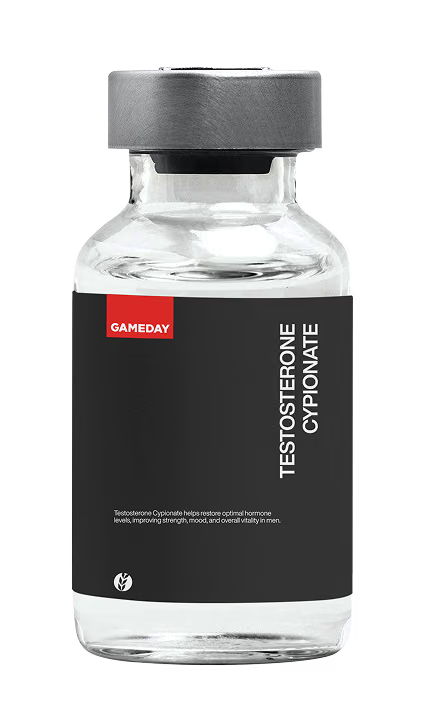
In most cases, yes. In men without a testosterone deficiency, luteinizing hormone (LH) and follicle-stimulating hormone (FSH) are released by the brain to control testosterone production and sperm development in the testicles, but this signaling stops with TRT use. “Testosterone from outside tells your brain production is covered, and the brain stops sending LH and FSH to the testicles. FSH is what keeps sperm production going,” explains Dr. Haleem Mohammed, MD, MBA, Global Chief Medical Officer of Gameday Men’s Health. “Without it, sperm production drops within weeks and often stops.”
In fact, according to the data reviewed by the American Urological Association (AUA) and the American Society for Reproductive Medicine (ASRM), approximately 65% of men drop to 0% sperm production within 6 months of starting TRT while sperm counts may fall below normal levels in many others.
“In our clinics, every new patient hears this before the first injection, whether or not he says he wants kids,” says Dr. Hal.
That conversation matters because you can’t necessarily tell when your sperm count has dropped. For younger men who may want children now or in the future, that makes it especially important to consider fertility before starting TRT rather than waiting until they’re ready to conceive.
If you’re experiencing symptoms of low testosterone, schedule an appointment at your local Gameday Men’s Health clinic to get your testosterone levels checked and talk with a provider about your symptoms, fertility goals and treatment options.
Can You Protect Your Fertility While on TRT?
Not necessarily. Unfortunately, there aren’t obvious symptoms of changes to your fertility making it hard to know where things stand once you’re on TRT. You can still have a healthy libido, normal erections and a typical amount of semen even if your sperm count has dropped to zero.
It’s also important to note that a lower dose of TRT doesn’t preserve fertility (a common misconception). As Dr. Hal explains, any amount of external testosterone that suppresses the brain’s LH and FSH signaling has the potential to suppress sperm production.
Another misconception is that the fertility drug Enclomiphene can work to protect fertility in men who are on TRT, but this is also false. “Enclomiphene works in the brain to raise LH and FSH,” explains Dr. Hal. “The brain is already suppressed, so the signal can't get through. The patient feels reassured because the clinic added a ‘fertility-preserving’ drug and nothing is being preserved.”
The only way to know what’s happening with your sperm count is through a semen analysis, which may be worth discussing with your provider before starting TRT if having children is part of your future plans.
Does Fertility Return After Stopping TRT?
Possibly. Studies show that for many men, sperm production can recover after stopping TRT, but it doesn’t happen overnight and there are no guarantees. “Partial or full recovery typically happens over three to 12 months after stopping, sometimes longer, and in some men it doesn’t happen at all,” says Dr. Hal.
How quickly fertility returns can depend on several factors, including your age, TRT dose and how long you’ve been on treatment. In general, older men and those who have used higher doses of testosterone for longer periods may face a slower or less predictable fertility recovery.
According to Dr. Hal, men in their late 30s who have been on high-dose TRT for years come into the clinic ready to conceive, only to learn for the first time that their treatment may have affected their fertility. “At that point, the options may be limited,” he says. “That’s why the conversation happens at the first visit and not the third.”
Can You Treat Low Testosterone Without Affecting Fertility?
If you have low testosterone and want to preserve your fertility, the first step is understanding what may be causing your low T in the first place before deciding how to treat it.
Factors like poor sleep, excess weight, alcohol use, and medications can all have an effect on testosterone levels. For men under 25, Dr. Hal recommends a more extensive evaluation to rule out underlying medical causes before deciding on treatment.
If testosterone levels remain low, there are treatments available beyond TRT that may be a suitable alternative. As mentioned earlier, Enclomiphene can be used to boost testosterone production in men. The fertility drug may be used as a standalone treatment instead of TRT to stimulate the body’s own LH and FSH signaling rather than supplying testosterone from an outside source.
In certain cases, hCG may also be considered to help maintain testicular function and sperm production, including for some men who ultimately use TRT. Research suggests that hCG may help maintain or restore sperm production in men with low testosterone, including those treated with TRT.
However, no approach comes with a guarantee of preserved fertility, which is why treatment should be individualized based on your testosterone levels, symptoms, underlying health and plans for having children.
Jillian Gordon, Writer
Jillian Gordon is a Los Angeles-based writer with over a decade of experience covering health and wellness. She has written extensively about longevity science, gut and immune health, nutrition, and emerging wellness trends, with a focus on helping readers make informed decisions about their health.
Dr. Haleem Mohammed, Global Chief Medical Officer
Dr. Haleem Mohammed, MD, MBA, is the Global Chief Medical Officer of Gameday Men’s Health and an award-winning board-certified internal medicine physician specializing in men’s health and performance, including hormone optimization, weight management, erectile performance, peptide and vitamin therapy, musculoskeletal recovery solutions, longevity and precision medicine.